Answer all questions in order. The sequence starts from early levels and gradually moves upward so the final report can estimate the best current working level.
0 of 64 answered0 correct
Question 1
Cambridge Primary 1
Which set shows 2 objects?
Explanation
The picture has exactly 2 objects.
Question 2
Cambridge Primary 1
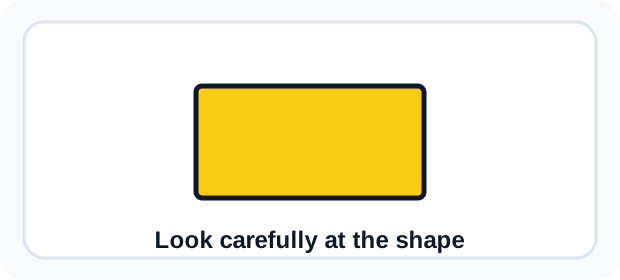
What shape is shown?
Explanation
A rectangle has four sides, with opposite sides the same length.
Question 3
Cambridge Primary 1
Which pair has the same length?
Explanation
Equal numbers of units mean the same length.
Question 4
Cambridge Primary 1
Which subtraction sentence equals 13?
Explanation
Eighteen minus five equals thirteen.
Question 5
Cambridge Primary 1
Complete the subtraction: 5 - __ = 3
Explanation
Five minus two equals three.
Question 6
Cambridge Primary 2
Which number is odd?
Explanation
37 is odd because it cannot be shared into pairs exactly.
Question 7
Cambridge Primary 2
A farmer has 24 eggs. He puts 6 eggs in each box. How many boxes can he fill?
Explanation
24 divided by 6 equals 4.
Question 8
Cambridge Primary 2
Round 46 to the nearest 10.
Explanation
46 is closer to 50 than 40.
Question 9
Cambridge Primary 2
Which number is 10 more than 63?
Explanation
Adding 10 to 63 gives 73.
Question 10
Cambridge Primary 2
Which number is even?
Explanation
28 is even because it can be shared into pairs exactly.
Question 11
Cambridge Primary 3
Which fraction is greater?
Explanation
\(\frac{1}{2}=\frac{4}{8}\), which is greater than \(\frac{3}{8}\).
Question 12
Cambridge Primary 3
There are 5 bags with 12 marbles in each bag. 8 marbles are lost. How many are left?
Explanation
5 x 12 = 60 marbles. 60 - 8 = 52.
Question 13
Cambridge Primary 3
What is one third of 24?
Explanation
24 divided by 3 equals 8.
Question 14
Cambridge Primary 3
There are 96 stickers shared equally among 8 children. How many stickers does each child get?
Explanation
96 divided by 8 equals 12.
Question 15
Cambridge Primary 3
What is 506 - 179?
Explanation
506 - 180 = 326, then add 1 back to get 327.
Question 16
Cambridge Primary 4
A recipe needs 250 g of flour for one cake. How much flour is needed for 5 cakes?
Explanation
250 g x 5 = 1250 g.
Question 17
Cambridge Primary 4
What is 12.5 - 4.86?
Explanation
Write 12.5 as 12.50. Then 12.50 - 4.86 = 7.64.
Question 18
Cambridge Primary 4
Which fraction is equivalent to \(\frac{3}{6}\)?
Explanation
\(\frac{3}{6}\) simplifies to \(\frac{1}{2}\).
Question 19
Cambridge Primary 4
A train leaves at 09:35 and arrives at 10:20. How long is the journey?
Explanation
From 09:35 to 10:00 is 25 minutes, then 20 more minutes gives 45 minutes.
Question 20
Cambridge Primary 4
A ribbon is 2.4 m long. It is cut into 4 equal pieces. How long is each piece?
Explanation
2.4 divided by 4 equals 0.6 m.
Question 21
Cambridge Primary 5
What type of angle is 90 degrees?
Explanation
A right angle is 90 degrees.
Question 22
Cambridge Primary 5
Which is smaller?
Explanation
0.25 is 25%, which is smaller than 30%.
Question 23
Cambridge Primary 5
Which fraction is equivalent to 15/20?
Explanation
Divide 15 and 20 by 5 to get 3/4.
Question 24
Cambridge Primary 5
Convert 3:45 pm to 24-hour time.
Explanation
Add 12 to the hour for pm times after noon.
Question 25
Cambridge Primary 5
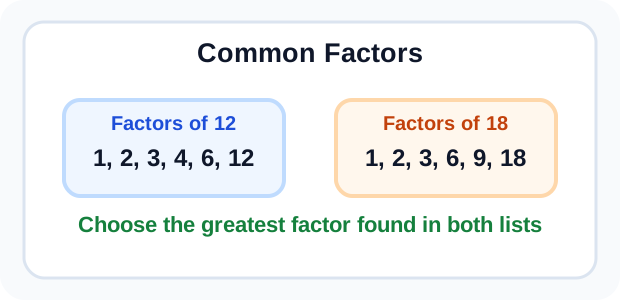
Use the model. What is the greatest common factor of 12 and 18?
Explanation
The common factors are 1, 2, 3 and 6, so the greatest is 6.
Question 26
Cambridge Primary 6
Find the highest common factor of 54 and 72.
Explanation
18 divides both 54 and 72, and no larger listed number does.
Question 27
Cambridge Primary 6
A car travels 150 km in 2.5 hours. What is its average speed?
Explanation
Speed is distance divided by time: \(150\div2.5=60\).
Question 28
Cambridge Primary 6
A triangle has angles 54 degrees and 67 degrees. Find the third angle.
Explanation
Angles in a triangle total 180 degrees. 180-54-67=59.
Question 29
Cambridge Primary 6
Which value is equivalent to 0.04?
Explanation 0.04=4 hundredths, which is 4%.
Question 30
Cambridge Primary 6
What is the next term: 3, 7, 15, 31, __?
Explanation
Each term doubles then adds 1: 31 doubled plus 1 is 63.
Question 31
Cambridge Lower Secondary 7
What is the probability of rolling an even number on a fair six-sided die?
Explanation
The even outcomes are 2, 4 and 6, so 3 out of 6.
Question 32
Cambridge Lower Secondary 7
Which is the median of 4, 9, 11, 12, 19?
Explanation
The middle value is 11.
Question 33
Cambridge Lower Secondary 7
Simplify 6a+4a-3a.
Explanation
Combine like terms: 6a+4a-3a=7a.
Question 34
Cambridge Lower Secondary 7
Find the circumference of a circle with radius 5 cm, using \(\pi=3.14\).
Explanation
Circumference is \(2\pi r=2\times3.14\times5=31.4\).
Question 35
Cambridge Lower Secondary 7
Simplify \(\frac{24}{36}\).
Explanation
Divide numerator and denominator by 12.
Question 36
Cambridge Lower Secondary 8
Calculate \(\frac{3}{5}\div\frac{6}{7}\).
Explanation
Divide by multiplying by the reciprocal: \(\frac{3}{5}\times\frac{7}{6}=\frac{21}{30}=\frac{7}{10}\).
Question 37
Cambridge Lower Secondary 8
Factorise x2+7x.
Explanation
Both terms share a factor of x.
Question 38
Cambridge Lower Secondary 8
Find the midpoint of (2, 7) and (8, 1).
Explanation
Average the coordinates: (2+8)/2=5, (7+1)/2=4.
Question 39
Cambridge Lower Secondary 8
A £240 item is discounted by 15%. What is the sale price?
Explanation
15% of 240 is 36, so the sale price is 240 - 36 = 204.
Question 40
Cambridge Lower Secondary 8
Solve 4(x-2)=20.
Explanation
Divide by 4 to get x-2=5, so x=7.
Question 41
Cambridge Lower Secondary 9
Solve \(\frac{x+4}{3}=2x-1\).
Explanation
Multiply by 3: x+4=6x-3. Then 7=5x, so \(x=\frac{7}{5}\).