Online Quiz: British Curriculum Primary 5 Science Quiz: Materials and Their Properties
Open Online Quiz: British Curriculum Primary 5 Science Quiz: Materials and Their Properties - 🔬 Science - Level 5 - Term 2 as an interactive British curriculum quiz with instant marking and explanations.
Level 5🔬 ScienceTerm 22025/2026Teacher: Almanahj
Scan to open this quiz
https://almanahj.com/uk/quizzes/5science2/115
Print Quiz
Choose the version to send to your printer or save as PDF.
Cambridge Primary 5 Science: Materials and Their Properties
This lesson quiz helps learners select materials for purposes by comparing properties such as hardness, flexibility, transparency and conductivity.
Result Tracking
0Answered
0Correct Answers
0Wrong Answers
0%Current Percentage
Quiz Completed
This is your final result after answering all questions. You can reopen the page to start again.
Question 1
1 point
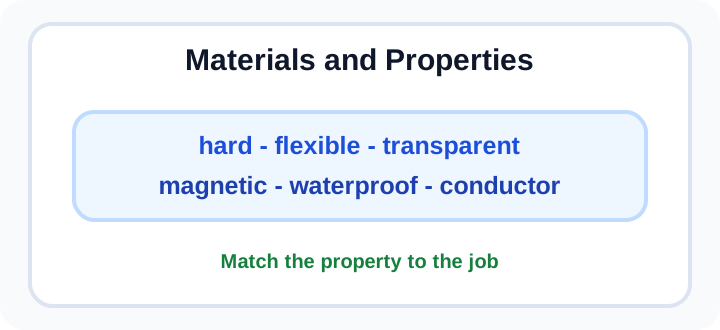
Use the model. Which property means light passes through clearly?
Explanation
Transparent materials allow clear vision through them.
Question 2
1 point
Which material is usually transparent?
Explanation
Glass lets light pass through clearly.
Question 3
1 point
Which property means a material bends without breaking easily?
Explanation
Flexible materials bend.
Question 4
1 point
Which material is usually flexible?
Explanation
Rubber can bend and stretch.
Question 5
1 point
Which property means a material resists scratching or denting?
Explanation
Hard materials resist indentation or scratching.
Question 6
1 point
Which property means water does not pass through easily?
Explanation
Waterproof materials resist water penetration.
Question 7
1 point
Which material is best for a raincoat?
Explanation
A raincoat must stop water reaching clothes.
Question 8
1 point
Which property is most important for electrical wires?
Explanation
Wires need to conduct electricity.
Question 9
1 point
Which material is a good electrical conductor?
Explanation
Copper is commonly used in wires.
Question 10
1 point
Which material is a good electrical insulator?
Explanation
Plastic does not conduct electricity well.
Question 11
1 point
Which property is useful for a saucepan base?
Explanation
Heat must transfer from hob to food.
Question 12
1 point
Which property is useful for a saucepan handle?
Explanation
An insulating handle stays safer to touch.
Question 13
1 point
Which object should be made from a strong material?
Explanation
Supports need strength under load.
Question 14
1 point
Which property matters for a towel?
Explanation
Towels need to soak up water.
Question 15
1 point
Which property means a material breaks suddenly when bent?