Online Quiz: British Curriculum Primary 5 Science Quiz: Reversible and Irreversible Changes
Open Online Quiz: British Curriculum Primary 5 Science Quiz: Reversible and Irreversible Changes - 🔬 Science - Level 5 - Term 2 as an interactive British curriculum quiz with instant marking and explanations.
Level 5🔬 ScienceTerm 22025/2026Teacher: Almanahj
Scan to open this quiz
https://almanahj.com/uk/quizzes/5science2/112
Print Quiz
Choose the version to send to your printer or save as PDF.
Cambridge Primary 5 Science: Reversible and Irreversible Changes
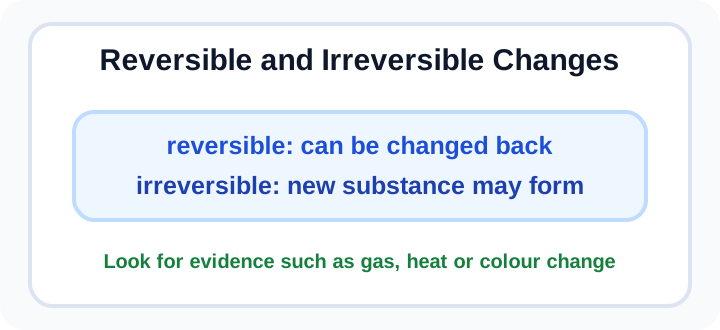
This lesson quiz helps learners distinguish reversible changes from irreversible changes using evidence from everyday materials.
Result Tracking
0Answered
0Correct Answers
0Wrong Answers
0%Current Percentage
Quiz Completed
This is your final result after answering all questions. You can reopen the page to start again.
Question 1
1 point
Use the model. Which change is reversible?
Explanation
Melting and solidifying can be reversed by cooling and heating.
Question 2
1 point
Which change is usually irreversible?
Explanation
Burning forms new substances such as ash and gases.
Question 3
1 point
What does reversible mean?
Explanation
Reversible changes can be undone.
Question 4
1 point
What often shows an irreversible change?
Explanation
Chemical changes often form new substances.
Question 5
1 point
Which is evidence that a new substance may have formed?
Explanation
Gas production can indicate a chemical reaction.
Question 6
1 point
Which is a reversible change involving salt?
Explanation
Evaporation can recover the salt.
Question 7
1 point
Which is an irreversible cooking change?
Explanation
Cooking egg changes proteins and cannot be undone easily.
Question 8
1 point
Which change is physical and reversible?
Explanation
The rubber can return to its shape.
Question 9
1 point
Why is rusting irreversible in everyday conditions?
Explanation
Rust is iron oxide, a different substance.
Question 10
1 point
Which pair is correctly classified?
Explanation
Wax can solidify again after melting.
Question 11
1 point
A sugar cube is crushed into powder. Is this reversible?
Explanation
The substance is still sugar, although the original cube shape is not easily restored.
Question 12
1 point
Which change forms a new substance?
Explanation
The reaction produces carbon dioxide gas and other products.
Question 13
1 point
What is the best test for reversibility?
Explanation
Recovery of the original material is key evidence.
Question 14
1 point
Which change is reversible by cooling?
Explanation
Cooling can solidify melted butter.
Question 15
1 point
Which change is reversible by heating?
Explanation
Heating melts ice.
Question 16
1 point
Which observation suggests an irreversible chemical change?
Explanation
Reactions may release or absorb thermal energy.
Question 17
1 point
Why is mixing sand and water reversible?
Explanation
The materials remain sand and water.
Question 18
1 point
Why is mixing cement with water usually irreversible?