Online Quiz: British Curriculum Primary 5 Science Quiz: Separating Mixtures
Open Online Quiz: British Curriculum Primary 5 Science Quiz: Separating Mixtures - 🔬 Science - Level 5 - Term 2 as an interactive British curriculum quiz with instant marking and explanations.
Level 5🔬 ScienceTerm 22025/2026Teacher: Almanahj
Scan to open this quiz
https://almanahj.com/uk/quizzes/5science2/113
Print Quiz
Choose the version to send to your printer or save as PDF.
Cambridge Primary 5 Science: Separating Mixtures
This lesson quiz helps learners choose suitable separation methods such as sieving, filtering, evaporation and magnetism.
Result Tracking
0Answered
0Correct Answers
0Wrong Answers
0%Current Percentage
Quiz Completed
This is your final result after answering all questions. You can reopen the page to start again.
Question 1
1 point
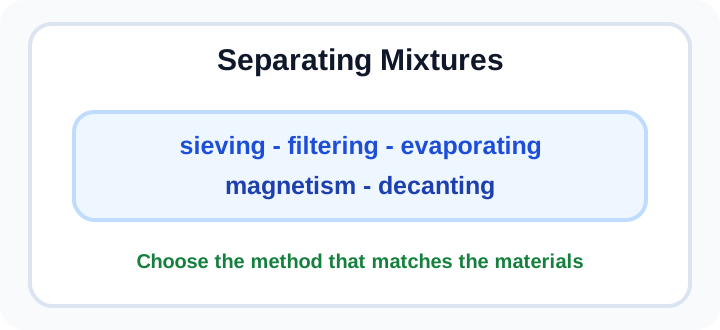
Use the model. Which method separates sand from water?
Explanation
Filter paper traps insoluble sand and lets water pass.
Question 2
1 point
Which method separates iron filings from sand?
Explanation
A magnet attracts iron filings.
Question 3
1 point
Which method separates large stones from soil?
Explanation
A sieve separates different-sized solid pieces.
Question 4
1 point
Which method can recover salt from salt water?
Explanation
Water evaporates and leaves dissolved salt behind.
Question 5
1 point
Which method can obtain cleaner water from muddy water first?
Explanation
Filtering removes insoluble particles.
Question 6
1 point
What is the solid left in filter paper called?
Explanation
Residue is trapped by the filter.
Question 7
1 point
What is the liquid that passes through filter paper called?
Explanation
The filtrate passes through.
Question 8
1 point
Which mixture is best separated by hand picking?
Explanation
Large visible solids can be hand sorted.
Question 9
1 point
Which mixture needs evaporation rather than filtering to get the solute?
Explanation
Dissolved salt passes through filters, so evaporating water recovers it.
Question 10
1 point
Why will filtering not remove dissolved sugar from water?
Explanation
Solutions cannot be separated by ordinary filtering.
Question 11
1 point
Which method separates oil floating on water carefully?
Explanation
One liquid layer can be poured off carefully.
Question 12
1 point
Which method separates a mixture using boiling points?
Explanation
Distillation evaporates and condenses a liquid.
Question 13
1 point
Why is safety important during evaporation?
Explanation
Heating requires care and adult supervision.
Question 14
1 point
Which property does sieving use?
Explanation
Sieve holes allow smaller pieces through.
Question 15
1 point
Which property does magnetic separation use?
Explanation
Magnetic materials are attracted to magnets.
Question 16
1 point
Which property does filtering use?
Explanation
Insoluble particles are too large to pass through.
Question 17
1 point
Which property does evaporation use?
Explanation
The liquid solvent evaporates.
Question 18
1 point
Which sequence separates sand and salt from a mixture?
Explanation
Salt dissolves, sand filters out, and evaporation recovers salt.
Question 19
1 point
Why should a separation method match the materials?