Online Quiz: British Curriculum Primary 5 Science Quiz: Forces and Motion
Open Online Quiz: British Curriculum Primary 5 Science Quiz: Forces and Motion - 🔬 Science - Level 5 - Term 3 as an interactive British curriculum quiz with instant marking and explanations.
Level 5🔬 ScienceTerm 32025/2026Teacher: Almanahj
Scan to open this quiz
https://almanahj.com/uk/quizzes/5science3/116
Print Quiz
Choose the version to send to your printer or save as PDF.
Cambridge Primary 5 Science: Forces and Motion
This lesson quiz helps learners interpret pushes and pulls, balanced and unbalanced forces, and changes in motion.
Result Tracking
0Answered
0Correct Answers
0Wrong Answers
0%Current Percentage
Quiz Completed
This is your final result after answering all questions. You can reopen the page to start again.
Question 1
1 point
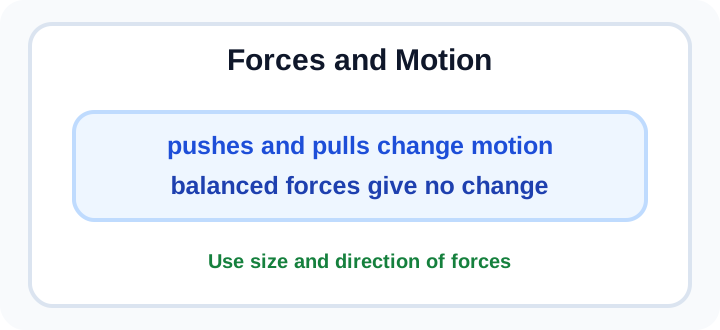
Use the model. What is a force?
Explanation
Forces are pushes and pulls.
Question 2
1 point
Which force can start an object moving?
Explanation
Unbalanced forces can change motion.
Question 3
1 point
What can forces change?
Explanation
Forces can affect motion and shape.
Question 4
1 point
If two equal forces act in opposite directions, what are they called?
Explanation
Equal opposite forces have zero resultant force.
Question 5
1 point
What happens when forces on a moving object are balanced?
Explanation
Balanced forces do not change velocity.
Question 6
1 point
What happens when forces are unbalanced?
Explanation
Unbalanced resultant force causes acceleration or deceleration.
Question 7
1 point
Which force pulls objects toward Earth?
Explanation
Gravity pulls masses together.
Question 8
1 point
Which force opposes sliding motion?
Explanation
Friction acts against relative motion between surfaces.
Question 9
1 point
Which force opposes motion through air?
Explanation
Air resistance is drag from air.
Question 10
1 point
Which is a contact force?
Explanation
Friction needs surfaces touching.
Question 11
1 point
Which is a non-contact force?
Explanation
Gravity acts at a distance.
Question 12
1 point
What is weight?
Explanation
Weight is a force measured in newtons.
Question 13
1 point
What unit is commonly used for force?
Explanation
Force is measured in newtons.
Question 14
1 point
Which instrument measures force?
Explanation
A force meter or newton meter measures force.
Question 15
1 point
A cyclist pedals harder and speeds up. What caused the speed change?
Explanation
The forward force exceeded opposing forces.
Question 16
1 point
A ball changes direction when kicked. What did the force change?
Explanation
Forces can change direction.
Question 17
1 point
A spring stretches when pulled. What did the force change?
Explanation
Forces can deform objects.
Question 18
1 point
Why does a heavier object often need a larger force to accelerate the same amount?
Explanation
More mass requires more force for the same acceleration.
Question 19
1 point
Which diagram would show a larger resultant force to the right?