Online Quiz: British Curriculum Primary 5 Science Quiz: Friction and Air Resistance
Open Online Quiz: British Curriculum Primary 5 Science Quiz: Friction and Air Resistance - 🔬 Science - Level 5 - Term 3 as an interactive British curriculum quiz with instant marking and explanations.
Level 5🔬 ScienceTerm 32025/2026Teacher: Almanahj
Scan to open this quiz
https://almanahj.com/uk/quizzes/5science3/117
Print Quiz
Choose the version to send to your printer or save as PDF.
Cambridge Primary 5 Science: Friction and Air Resistance
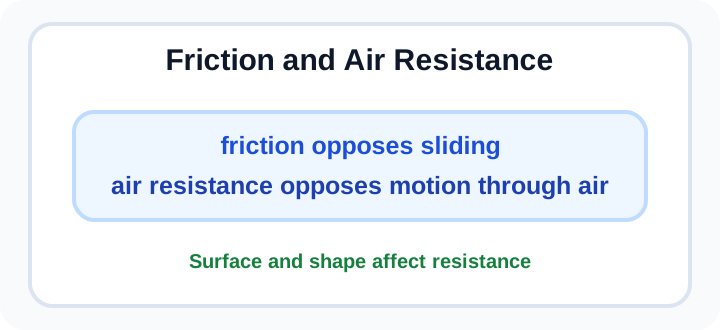
This lesson quiz helps learners explain friction, air resistance and how surfaces and shapes affect motion.
Result Tracking
0Answered
0Correct Answers
0Wrong Answers
0%Current Percentage
Quiz Completed
This is your final result after answering all questions. You can reopen the page to start again.
Question 1
1 point
Use the model. What does friction do?
Explanation
Friction acts against sliding motion.
Question 2
1 point
Which surface usually creates more friction?
Explanation
Roughness increases interlocking between surfaces.
Question 3
1 point
Why do shoes have tread?
Explanation
Tread helps prevent slipping.
Question 4
1 point
When is low friction useful?
Explanation
Low friction allows smoother sliding.
Question 5
1 point
When is high friction useful?
Explanation
Brakes use friction to slow motion.
Question 6
1 point
What is air resistance?
Explanation
Air resistance is drag.
Question 7
1 point
Which object has more air resistance when falling?
Explanation
A larger area pushes against more air.
Question 8
1 point
Why does a parachute slow a person?
Explanation
More drag reduces falling speed.
Question 9
1 point
Which shape is streamlined?
Explanation
Streamlined shapes reduce air resistance.
Question 10
1 point
Why are racing cars shaped smoothly?
Explanation
Lower drag helps speed and efficiency.
Question 11
1 point
What happens to air resistance as speed increases?
Explanation
Faster motion through air creates more drag.
Question 12
1 point
What is water resistance?
Explanation
Water resistance is drag in water.
Question 13
1 point
Which animal shape reduces water resistance?
Explanation
Streamlining helps movement through water.
Question 14
1 point
Which test compares friction fairly?
Explanation
Only surface should change.
Question 15
1 point
What should be kept the same in that friction test?
Explanation
Mass should be controlled.
Question 16
1 point
What is the dependent variable in that friction test?
Explanation
This measured force indicates friction.
Question 17
1 point
Why does oil reduce friction between machine parts?
Explanation
Lubrication reduces contact between surfaces.
Question 18
1 point
Which statement about friction is accurate?
Explanation
Friction helps grip but can slow motion and cause wear.