Online Quiz: British Curriculum Primary 5 Science Quiz: Light and Shadows
Open Online Quiz: British Curriculum Primary 5 Science Quiz: Light and Shadows - 🔬 Science - Level 5 - Term 3 as an interactive British curriculum quiz with instant marking and explanations.
Level 5🔬 ScienceTerm 32025/2026Teacher: Almanahj
Scan to open this quiz
https://almanahj.com/uk/quizzes/5science3/118
Print Quiz
Choose the version to send to your printer or save as PDF.
Cambridge Primary 5 Science: Light and Shadows
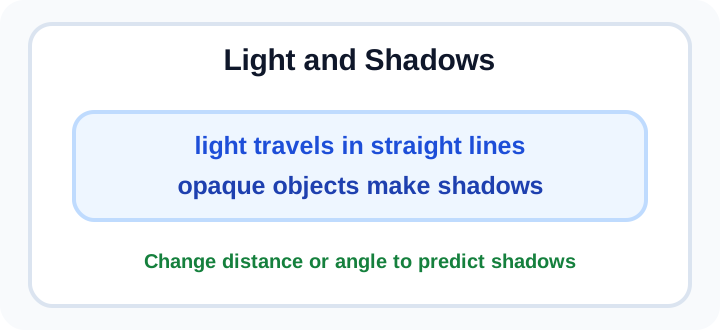
This lesson quiz helps learners explain how light travels, how shadows form and how distance affects shadow size.
Result Tracking
0Answered
0Correct Answers
0Wrong Answers
0%Current Percentage
Quiz Completed
This is your final result after answering all questions. You can reopen the page to start again.
Question 1
1 point
Use the model. How does light travel in a uniform material?
Explanation
Light travels in straight lines in uniform media.
Question 2
1 point
What is needed to see an object?
Explanation
We see when light reaches our eyes.
Question 3
1 point
Which object is luminous?
Explanation
The Sun produces its own light.
Question 4
1 point
Why can we see the Moon?
Explanation
The Moon is seen by reflected sunlight.
Question 5
1 point
What is an opaque material?
Explanation
Opaque objects do not let light pass through.
Question 6
1 point
What is a transparent material?
Explanation
Transparent materials allow clear images through.
Question 7
1 point
What is a translucent material?
Explanation
Translucent materials blur images.
Question 8
1 point
How is a shadow formed?
Explanation
A shadow is the dark region behind a blocker.
Question 9
1 point
Which object makes the darkest shadow?
Explanation
Opaque card blocks most light.
Question 10
1 point
What happens to a shadow if an object moves closer to a light source?
Explanation
Closer objects block a wider cone of light.
Question 11
1 point
What happens to a shadow if the screen moves farther from the object?
Explanation
Distance affects size and sharpness.
Question 12
1 point
Why do shadows change during the day?
Explanation
Changing light direction changes shadow direction and length.
Question 13
1 point
When are outdoor shadows often shortest?
Explanation
The Sun is highest, so shadows are shorter.
Question 14
1 point
Which surface reflects light best?
Explanation
Smooth shiny surfaces reflect light regularly.
Question 15
1 point
What is reflection?
Explanation
Reflection changes the direction of light.
Question 16
1 point
Which colour usually absorbs more light energy?
Explanation
Black surfaces absorb more light and reflect less.
Question 17
1 point
Which investigation is a fair test of shadow size?